
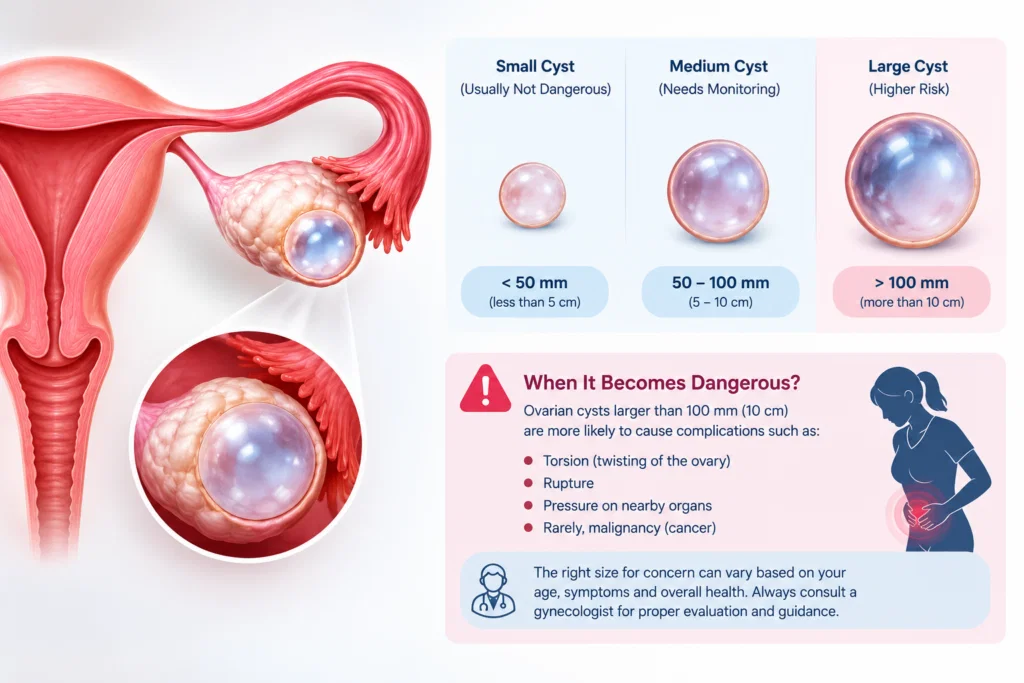
Hearing that you have a cyst on your ovary can be scary. Most women search for one answer right away: what size of ovarian cyst is dangerous in mm? The size on your ultrasound report is a big part of the answer, but it is not the whole story.
Most ovarian cysts are harmless and go away on their own. Still, some grow large enough to cause pain, twisting, or rupture. This guide explains the size ranges doctors watch, the symptoms to look out for, and the treatments available.
What is ovarian cyst? It is a fluid-filled sac that forms on or inside an ovary. Every woman has small cysts during her reproductive years. Each month, a follicle grows on the ovary and releases an egg. If that follicle does not open or shrink afterward, it can swell into a functional cyst.
Doctors measure an ovary cyst in millimeters (mm) or centimeters (cm). Ten millimeters equal one centimeter. So a 50 mm cyst is the same as a 5 cm cyst.
The most common ovarian cyst causes include:
Here is the general rule. A cyst under 50 mm is usually safe and often resolves in a few menstrual cycles. A cyst between 50 and 70 mm needs follow-up scans. A cyst above 70 mm needs specialist evaluation, and one above 100 mm often needs surgery.
Cyst Size (mm) | Risk Level | What Doctors Usually Do |
Under 30 mm | Very low | Usually no follow-up needed |
30 to 50 mm | Low | Watchful waiting, repeat scan if needed |
50 to 70 mm | Moderate | Follow-up ultrasound in 6 to 12 weeks |
70 to 100 mm | High | MRI and specialist review |
Over 100 mm | Very high | Surgery is often recommended |
These ranges are guides, not strict rules. Your age, symptoms, and the look of the cyst matter just as much as the number.
Before menopause, hormones keep creating new follicles. So most cysts are functional and temporary. In this group, what size of ovarian cyst is dangerous usually starts around 50 mm. Cysts below this size seldom cause trouble. Once a cyst passes 50 mm, the chance of twisting (torsion) or rupture goes up. Above 100 mm, doctors usually plan a cyst operation because the cyst is unlikely to shrink on its own.
After menopause, the ovaries stop releasing eggs, so new functional cysts should not form. Any ovarian cyst found at this stage gets closer attention. Even a cyst of 30 to 50 mm may be monitored with blood tests and repeated scans. A growing or complex cyst in this age group has a higher chance of being serious, so early review is important.
When you ask what size of ovarian cyst is dangerous, remember that the shape and content of the cyst also count. A small cyst with worrying features can be riskier than a big, simple one. Doctors also look at:
Your report may use unfamiliar words. An anechoic cyst is one that looks completely black on ultrasound because it holds clear fluid and no solid material. This is the classic picture of a simple cyst, and these are almost always benign.
A hemorrhagic cyst is different. It forms when a bit of bleeding happens inside a functional cyst. On a scan, it often looks lacy or contains echoes from the blood. A hemorrhagic ovarian cyst can cause sudden one-sided pain, but most of them shrink without any treatment within six to eight weeks.
Some people also search for a cyst in uterus. Strictly speaking, ovarian cysts grow on the ovaries, not inside the uterus. Cysts found in or near the uterus, such as nabothian cysts on the cervix, are a separate issue. Your scan report will state clearly where the cyst is located.
Many women feel nothing at all. When they do appear, ovarian cyst symptoms can include:
Go to an emergency room if you have any of the following:
These signs can point to a ruptured cyst or ovarian torsion, which is a medical emergency. A cyst larger than 50 mm raises the chance of torsion, but it can happen with smaller ones too.
Ovarian cyst treatment depends on size, type, symptoms, and age. Most women never need surgery.
Watchful waiting. For small, simple cysts, doctors often just repeat the ultrasound after one to three months. Many cysts disappear by themselves.
Medication. Pain relievers can ease discomfort. Hormonal birth control pills do not shrink existing cysts, but they can stop new ones from forming by preventing ovulation.
Surgery. A cyst operation is usually advised when a cyst is larger than 70 to 100 mm, keeps growing, causes constant pain, or looks suspicious on imaging. There are two main types:
In many cases the surgeon removes only the cyst and saves the ovary. This matters especially for women who plan to have children.
Knowing what size of ovarian cyst is dangerous in mm helps you read your report with more confidence. If your cyst is 25 mm and simple, you can relax. If it is 65 mm, you know that a follow-up scan is a sensible step, not a reason to panic. If it is over 100 mm, you can prepare for a talk with your surgeon.
Just remember that numbers alone never decide the treatment. Always discuss your report with a gynecologist who can look at the full picture.
You cannot prevent every cyst, but a few habits help:
See a doctor if your periods change suddenly, you feel constant bloating, or your pelvic pain lasts more than a few days. After menopause, report any pelvic symptoms promptly.